Planning
This article contains affiliate links. If you book through them, I may earn a small commission at no extra cost to you. Learn more
You found a glamping resort in Japan that looks perfect. Then the booking page turns out to be Japanese-only, the form wants a phone number that starts with 0, and your card gets declined for no stated reason.
This is the point where most foreign visitors give up and book a hotel instead.
It's solvable, and in most cases it's easier than it looks. I work at a glamping resort in Japan and I see both sides of this — the guests who book smoothly, and the enquiries that arrive by email at 2am because someone couldn't make a form work.
Here's what actually blocks bookings, and what to do about each one.
Before troubleshooting anything, check whether the resort you want is on an international platform. If it is, none of the rest of this page applies to you.
Glamping is the most foreign-visitor-friendly corner of Japanese accommodation. It's a newer industry built partly for international demand, so English support is far more common than it is for small traditional inns or basic campgrounds.
Check, in this order:
If you find your resort at step 1, book it and stop reading. The rest of this is for when it isn't there.
This is the hardest one, and the only blocker that genuinely stops some people.
Several Japanese booking platforms send an SMS verification code to create an account, and the field only accepts a domestic number. If you're visiting for two weeks, you don't have one.
What works:
What to be careful with: online services offering a "virtual Japanese number" to receive the code. Some are fine, some are scrapers. Don't put a card number into one to save yourself a booking fee.
Real, but not universal, and usually fixable.
Japanese payment systems sometimes reject overseas-issued cards — occasionally the card's own fraud filter blocking an unfamiliar foreign merchant, occasionally the Japanese gateway not accepting non-domestic cards at all. There's rarely a useful error message either way.
What works, in order:
Bring cash as a backup. Japan is less cash-dependent than it used to be, but rural resorts are the exact kind of business that may still be cash-preferred for extras — firewood, drinks, an extra BBQ set. See my cost guide for what tends to be charged on the day.
The least serious of the four. Browser translation handles it.
Chrome or Edge on a laptop: right-click the page and choose Translate. Safari: the translate icon in the address bar. On a phone: use Google Translate's camera mode on the form fields, or open the page in Chrome and translate it there.
Two things translation gets wrong, so check them in the original:
Fields that trip people up:
| Japanese | What it means | What to put |
|---|---|---|
| お名前 / 氏名 | Your name | Family name first is fine |
| フリガナ / カナ | Name in katakana | Many forms reject Latin letters here — ask the resort, or use a name-to-katakana converter |
| 電話番号 | Phone number | Your mobile with country code if it accepts it |
| 郵便番号 | Postal code | Some forms require a 7-digit Japanese format |
| 人数 | Number of guests | Adults and children are usually counted separately |
| 泊数 | Number of nights | |
| 備考 / ご要望 | Notes / requests | Where you write your dietary needs and shuttle request |
If the katakana field or the Japanese postal code blocks you, stop filling in the form and email instead. That's not a failure — it's the faster route.
Some smaller resorts genuinely take reservations by phone only. If you don't speak Japanese, this one is a wall.
Don't call. A phone call in a language you don't share, about dates and numbers, goes badly for everyone.
Email instead, even if the site doesn't invite it. Most resorts have a contact address somewhere on the page, and an email in English gets read — often by someone who couldn't have handled it live on the phone but can manage it in writing with a translation tool. This is the single most underused option, and it's how a good share of our own international bookings arrive.
If you email a Japanese glamping resort, the shape of the message matters more than the language. Short, structured, every fact in a labelled line. A long polite paragraph is harder for a non-native reader to process than a list.
Copy this:
Subject: Reservation request — 5–6 December, 2 adults
Hello,
I would like to request a reservation.
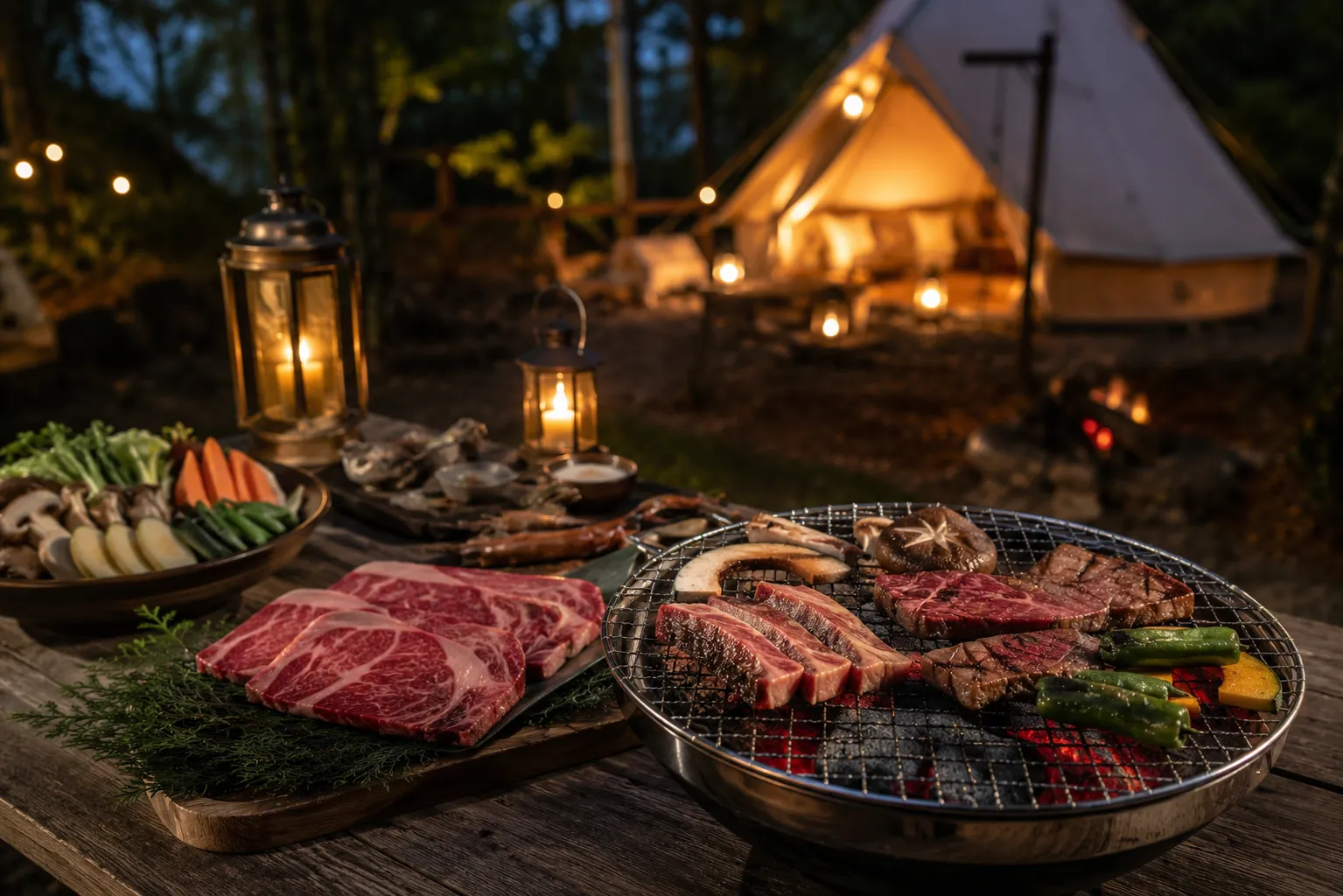
Check-in: 5 December 2026 Check-out: 6 December 2026 Nights: 1 Guests: 2 adults Accommodation type: dome tent (if available) Dinner: yes, BBQ — one guest cannot eat pork Arrival: by train to [station], arriving about 15:30. Is a shuttle available? Payment: I have a Visa card issued outside Japan. May I pay at the property if the card is not accepted online? Could you confirm availability and the total price for 2 people?
Thank you,
[Your name]
Why this works: every question a resort needs answered is already answered, so nobody has to write a paragraph back asking. Bold labels survive machine translation almost perfectly. And asking the card question upfront prevents the one failure mode that actually loses bookings — someone arriving with a card nobody can charge.
Expect a reply within one business day, two over a weekend. If nothing comes in three days, the address is probably unmonitored — move on to a resort on Booking.com rather than waiting.
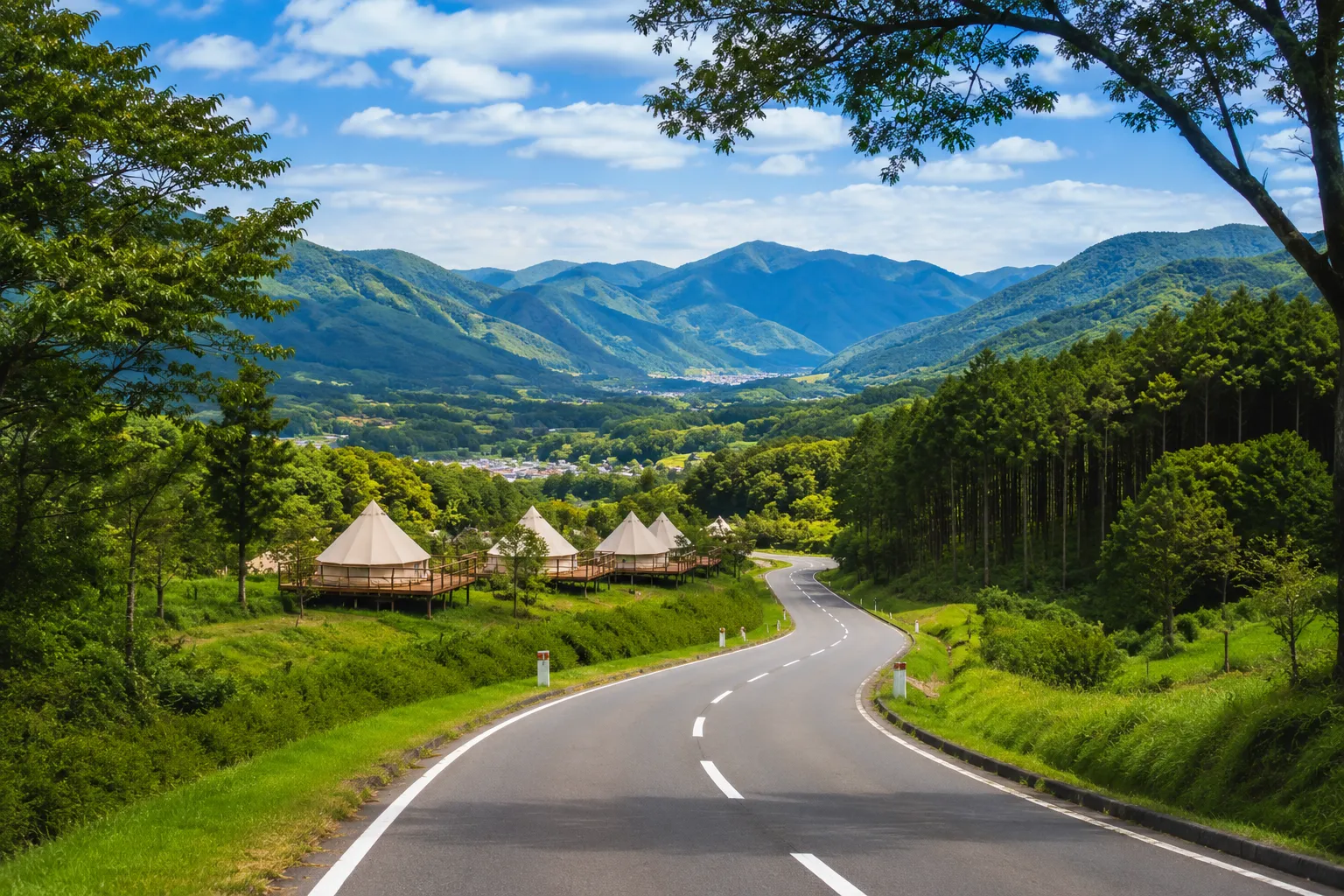
This is the mistake I see most often, and it isn't a payment problem at all. People book successfully, then discover the resort is 15 minutes from the station with no bus.
Most glamping resorts run a free shuttle. Almost none let you book it online. You arrange it by email or phone, usually the day before, and it has fixed departure times tied to the station.
So ask in the same email you use to book. "Is a shuttle available from [station] at around [time]?" If the answer is no, find out the taxi situation before you commit — rural Japanese taxis often have to be phoned rather than hailed, and the last one may finish early in the evening.
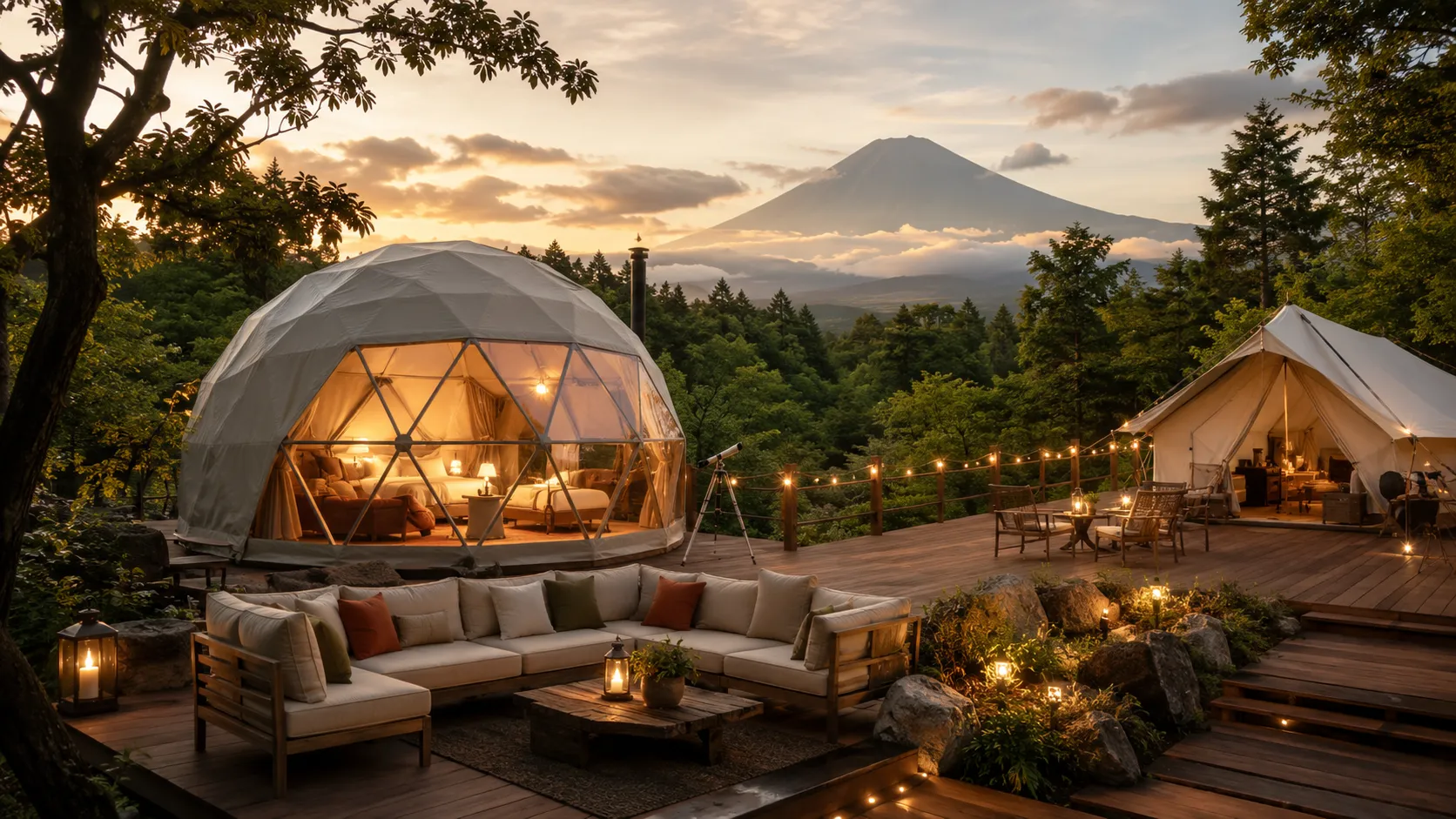
My car-free glamping guide covers which areas work reliably without a car. Lake Kawaguchiko is the most dependable, with a direct highway bus from Shinjuku — and those bus tickets can be booked in English in advance, which matters because they cannot be bought onboard.
Worth knowing before you commit, because glamping is catered. The food is ordered for you specifically.
Typical Japanese glamping cancellation terms run something like: free until 7–10 days out, then 20–30% at 7 days, 50% at 3 days, 80–100% on the day. Stricter than a city hotel, and stricter than most Western glamping.
Two practical consequences:
Yes. Use Booking.com and search by area name, or check whether the resort has an English version of its own site. For anything only bookable domestically, email in English rather than phoning — it works far more often than visitors expect.
Not on international platforms. Some Japanese platforms require one for SMS account verification, which is a genuine blocker. The simplest answer is to book a resort that's listed internationally; alternatives are a Japanese eSIM with an SMS-capable number, emailing the resort directly, or asking your Tokyo hotel's front desk to call.
Usually, but not always. Visa and Mastercard have the widest acceptance. If a card is declined, choose "pay at the property" where offered, try a different brand, notify your bank, and wait a day before retrying. Carry some cash for on-site extras.
Occasionally, by a small margin, and sometimes with an extra included. But direct booking is where all four blockers live — Japanese forms, domestic phone verification, card problems, phone-only reservations. For a first trip, the international platform is worth the small premium. See my cost guide for where the money actually goes.
Four to eight weeks for a weekend. Several months for Golden Week (late April to early May), Obon (mid-August) or New Year. A weekday outside those periods is often available at short notice. Weekends are the constraint, not the season.
Put it in the 備考 (notes) field, or in your email, in plain terms — name the ingredient rather than the dish. BBQ is much easier to adapt than a traditional multi-course dinner, and resorts would far rather know a week ahead than at the grill. If the allergy is severe, email directly even when booking through a platform, so it's in writing with the resort itself.
Sometimes, on a weekday or in winter. Weekends and holidays are usually gone weeks ahead. Filter for free cancellation and check Booking.com for live availability — and see my guide to finding glamping near where you're staying.
Check the booking platforms rather than the website. Many small Japanese resorts maintain their listings diligently and their own site barely at all, so a site last updated two years ago may be running perfectly well. Live availability on Booking.com or Rakuten Travel is the reliable signal.
The language barrier around Japanese glamping is real, but it's thinner than it appears from the outside. Almost nobody who gets as far as emailing a resort ends up unable to book.
For activities to build around your stay, GetYourGuide covers Fuji day trips, lake sports and cultural experiences in English — and if you want to know what you've actually signed up for, my hour-by-hour walkthrough of a glamping stay covers check-in to checkout.
Book your stay and your activities with English-language support, international payments, and flexible cancellation.